
Ariel Anderssen, China Hamilton and a World I Hadn't Entered
Sometimes influence is less about how a photograph looks than about what it makes possible.
China Hamilton’s photographs gave Ariel Anderssen visible evidence of an erotic world she had already begun to imagine. Years later, meeting Ariel did something quieter but structurally similar for me: it turned an imagined erotic photographic practice into something I could actually enter.
Published by Atelier Wilfredson
Written by Nikolas Wilfredson 2026
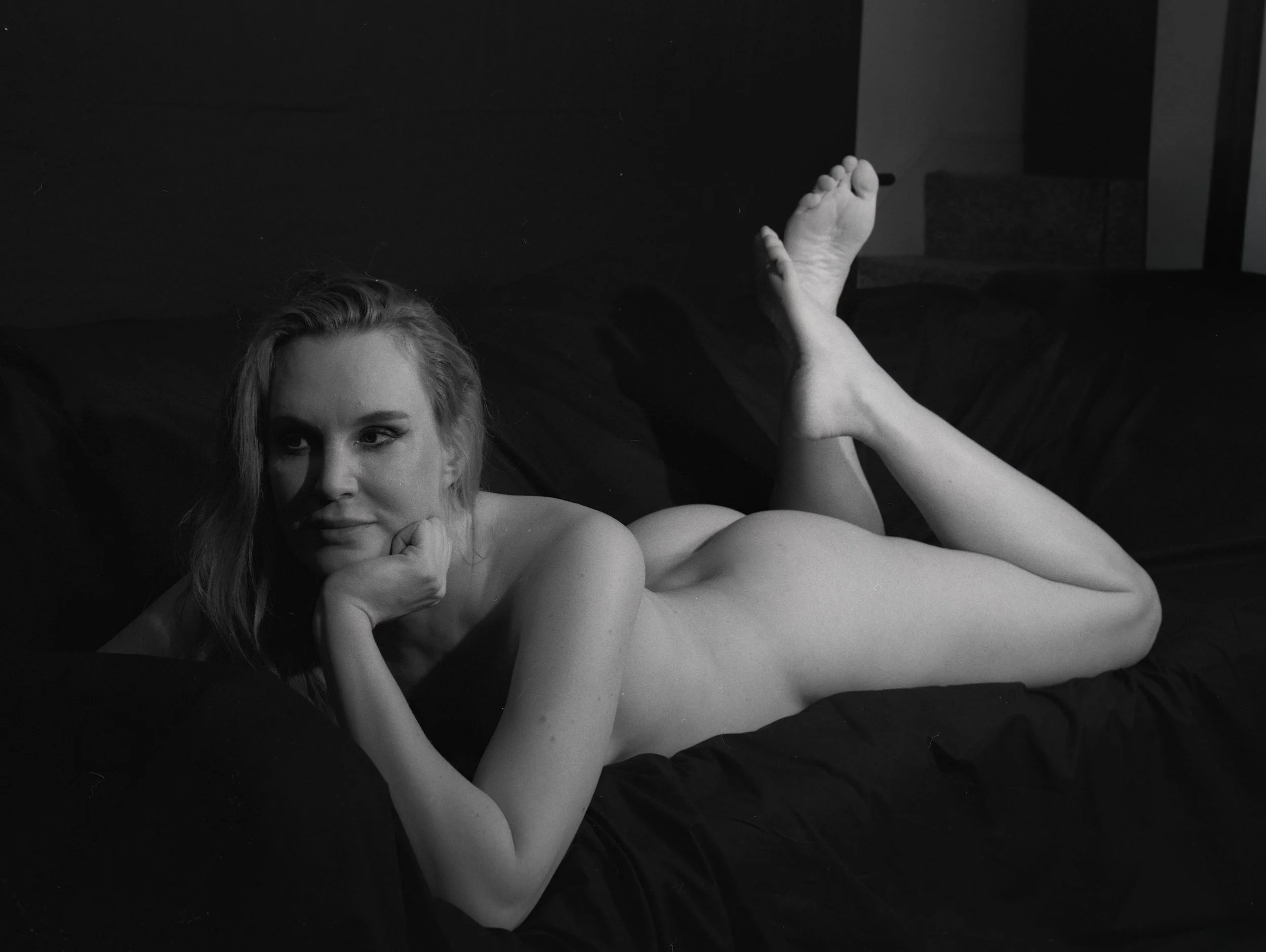
The last time I photographed Ariel Anderssen, China Hamilton came up in conversation. I had brought a book I had made from our previous sittings, an edit of the photographs I thought were the strongest, and we were talking about Atelier Wilfredson and the photographers who had influenced me. Hamilton is one of them. I respond to the darkness and density of his black-and-white work and to the way the photographs can be explicitly erotic without their eroticism becoming the only reason to look at them. Ariel's connection with him is considerably more direct. She modelled for him several times, appears on the cover of one of his books, and writes in her memoir Playing to Lose about the effect of first encountering his art before she knew him.
Her account is striking because Hamilton's photographs did more than appeal to her aesthetically. She describes recognising in them desires and fantasies which, until then, had largely existed privately in her imagination. She did not yet have much of the vocabulary particular to BDSM, still less a sense of the social world around it. The exhibition showed her that this world existed outside her own head and that she was not alone. She then met Hamilton, talked with him about BDSM and sexuality and was later photographed by him. The progression is clear. The photographs gave an imagined world a physical form. Meeting Hamilton made that same world human. Being photographed by someone who already inhabited that culture allowed Ariel to begin inhabiting it herself.
It was only while talking about this with Ariel during our most recent sitting that I began to see a parallel with my own first encounter with her. The experiences are not equivalent, but Ariel's encounter with Hamilton was bound up with the emergence of an erotic identity that would become central to her life and work. I already knew that erotic photography was the art I wanted to make. What I lacked was a route into making it. I think I simply searched online for nude models and found PurplePort. It was not a revelation so much as a practical discovery. There was an established network of professional models and, through a formal process, I could contact one of them.
Ariel caught my attention partly because of her appearance and partly because of what her profile suggested about her. She was exceptionally tall, blonde, mature, experienced and openly kinky. I had never photographed a professional model and was nervous enough about my own competence without wanting the person in front of the camera to be equally uncertain. Her experience was reassuring. Only later did I understand how much it shaped the encounter. I might own the camera and decide what entered the frame, but Ariel knew far more than I did about working nude, posing, performance and the erotic territory we were entering.
We met on a grey winter afternoon in a repurposed Victorian mill in Manchester. Ariel arrived with a large suitcase because she was on a modelling tour. Elsewhere in the building, bands were rehearsing, and dance classes were taking place. I remember the impact of her physical presence when we met in the communal lobby. She is over six feet tall, and that presence does not fully translate through a photograph. Otherwise, the encounter was reassuringly ordinary. We carried the suitcase upstairs to the studio, talked about clothes, cameras, lighting, food and tea, and established how we would work. I told her that this was my first shoot with a professional model. She knew how to pose. I knew the camera, the lens and the limits of the composition. I would set the frame, and she would work within it.
There was no private changing area in the studio. That created a small but important moment before the photography began. The person who had arrived for a professional appointment still needed to change into the identity she would inhabit in front of the camera as Ariel. I regarded that transition as private even though the room could not provide privacy physically, so I turned my attention to cameras and lights while she changed. Once that transition was complete, the situation was different. Ariel was comfortable being naked because nudity belonged to the professional and erotic identity she had spent years learning to inhabit. Respecting the boundary between the private person and that chosen identity was part of the trust required for the work.
This distinction has become increasingly important to how I understand erotic portraiture. The sitter is not simply removing clothes. She may also be entering a persona which allows aspects of herself to become visible that ordinary social life keeps contained. In Ariel's case, that persona is not fictitious. It is a deliberately developed erotic self, carefully shaped by experience, fantasy, and choice. The fact that it is performed does not make it inauthentic. Performance can be how something genuine becomes possible.
Once Ariel was ready to work, looking was no longer something to avoid. It was the work. Allure and aesthetic appreciation are not contaminants that have to be removed before an erotic photograph can become art. They are part of why I photograph the individual person at all. The question is what the photographer does with that attention. I am not trying to look erotically at somebody as though eroticism were a switch that I turn on. I am looking for the erotic in the situation and trying to translate it into an image without allowing the person who offers it to disappear behind the desire it creates. Photography is necessarily selective. It frames one aspect of a person while excluding countless others. Erotic photography makes that selectivity unusually visible because attraction, the body and the act of looking are so closely connected.
We began with fairly formal portraits and moved gradually towards more explicitly nude photographs. I would establish a composition, and Ariel would respond to it. Her movement might alter what I had imagined, and the next photograph would develop from that response. The value of her experience was not simply that she could produce poses on command. She could inhabit the frame as Ariel and contribute to what the photograph became. I supplied one kind of knowledge and she supplied another. The picture depended on both, even though our responsibilities were different.
As I became more technically competent, I no longer had to divide my attention so sharply between the camera and the sitter. In the early sittings, the more absorbed I became in conversation and in watching the sitter, the easier it was to make an elementary mistake with exposure, focus or the camera. Experience gradually pushed the mechanics into the background. The technical decisions remained mine, but they became more instinctive, leaving me freer to attend to the person in front of me. The sitter had always been central to the work. What changed was my ability to give her that attention without losing control of the photographic process.
There was no Atelier Wilfredson on that first afternoon, but many of the personal values that would later be formalised within it were already present. Respect for the person came before any theory of sitter agency. Attention to privacy, boundaries and trust came from ordinary human conduct rather than an artistic manifesto. I was trying to behave properly towards another person while also making photographs. Atelier later gave those instincts a clearer language and made them part of a consciously articulated practice.
The comparison with Hamilton becomes more interesting when the two encounters are placed beside one another. When Ariel first encountered his work, she was already moving towards the erotic identity she would eventually inhabit as Ariel. Hamilton did not create that trajectory. His photographs gave something she had imagined a visible form and meeting him provided one route through which imagination could become a lived experience. By the time I met Ariel, that process had been underway for years. She arrived with a developed erotic identity, substantial modelling experience, and confidence in that world which I did not yet possess.
My own trajectory has a similar shape, even though its subject is different. I already wanted to create erotic photographs. PurplePort did not create that desire, and Ariel did not create the artistic practice that later became Atelier Wilfredson. What meeting her provided was a way for an existing aspiration to become real. The imagined practice became a professional sitting, then photographs, then repeated encounters, and eventually a body of work from which Atelier could develop.
That is the connection I now see between Ariel's encounter with Hamilton and my encounter with Ariel. Neither story is about one person determining another's future. The direction was already there. What the encounter supplied was a route from imagination into experience. Ariel had imagined a self that could inhabit the erotic world she saw in Hamilton's photographs. I had imagined an erotic photographic practice without yet knowing how I would inhabit it. Hamilton became part of the route by which Ariel could become Ariel. Ariel became part of the route by which my own imagined practice could become something tangible.