
The Moment a Subject Stops Performing
The moment a subject stops performing rarely begins in front of the camera.
It begins earlier, in messages exchanged, portfolios reviewed and impressions formed. Before a sitter agrees to be photographed, she is already asking questions: Who is this person? Can I trust them? Am I safe? Will I be seen, or merely observed?
The photographs that follow are shaped by the answers. Trust, once established, alters the nature of the encounter. The professional model arrives first. The person arrives later.
Published by Atelier Wilfredson
Witten by Nikolas Wilfredson 2026
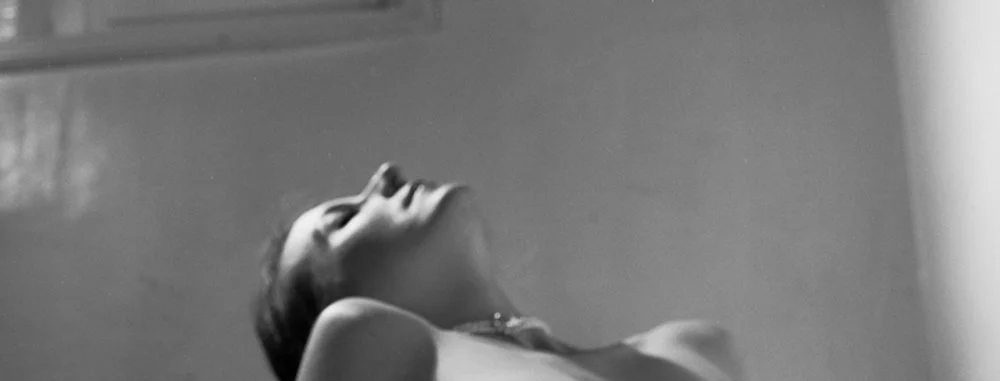
Trust accumulates before the sitter enters the room.
Every sitting begins with an approach. A message, an enquiry, an invitation: would you work with me? Here I am – this is my statement, these are my values, these are some of the images I’ve made, this is what people have said about my work, my approach.
“Maybe, tell me more... Make it so I trust you.”
What emerges, sometimes over weeks, is a perception; a blurred sense of a person, a presence, an aesthetic.
‘Here is a mood board, do you like it?’ Does it resonate with your dreams? Here is the aesthetic; does it capture how you are? Here is the theme, have you experienced this in your personal life, can you relate?
It’s to be art nude, it’s to be erotic...
“What does that mean... to you?”
How does a stranger decide whether another stranger is safe?
The models I have worked with appear to notice small acts of care long before they notice the camera. Trust grows when another person's wellbeing is treated as important.
My professionalism creates predictability. I am the seer, that is witnessed consciously and unconsciously by the model, the seen, building into an opinion.
Models talk about rapport, want to describe things they are interested in, and excited by, want that to be seen as well as their physicality. We build connections, build confidence, and build trust.
She has creativity, experience, an aesthetic, a presence, a look; that is her. My task is to see it and communicate it on. And professionalism does not waver, that professionalism is the consistency; it is in the communication, in the organization – where, when, how long, how much, what – all agreed and written down. This professional is who this person appears to be.
That is what the photographer is working with: not cameras and film, but trust. The belief held by the person who has agreed to be seen.
Tea?
How do you take it? Asked because it matters. Asked because it is taking care. It matters.
Here is a private space, a changing room, mirror for make up, lights. The studio, the furniture the lights, the cameras. A private space because it matters. The seeing and the seen occurs in front of the camera, for the camera. Otherwise that person is private.
The cameras inevitably become part of the conversation. Their size, age and unfamiliarity invite curiosity, and the question is almost always the same: why? Over time they cease to be merely tools. Some models eventually ask to be photographed with them. I suspect this is not simply because the cameras are beautiful objects, but because they have become part of the world we are creating together. By that point they no longer signify the photographer alone. They have come to represent the work itself.
We begin with portraits. A plain background, little distraction, nowhere to hide. The differences between one frame and the next are often small: a hand, a shoulder, the angle of a face. Conversation continues. We talk. We catch up. We settle into the rhythm of making photographs together. The portraits are not the destination. They are a way of arriving.
As the sitting progresses, conversation drifts away from the photographs. We talk about ordinary things: journeys, work, how the day began. Direction is followed almost absent-mindedly as attention shifts elsewhere. Nothing has changed, and that is precisely the point. The photographer remains the same person who wrote the messages, planned the sitting and welcomed the model through the door. Trust no longer requires attention because it has become assumed.
The professional model often arrives first. The person arrives later. Not because the persona disappears, but because it no longer needs to be maintained. The aesthetic remains. The individuality remains. What fades is the effort of presentation. Freed from the need to manage the interaction, the sitter begins to choose what to reveal rather than what to conceal. It is often around this point that something shifts. Not dramatically, but noticeably. The photographs become less about posing and more about presence.
Professional models know how to pose. It is their craft. Over years of practice they acquire an extensive visual vocabulary: expressions, gestures, postures and archetypes. Some arrive from dance, some from theatre, some from yoga, some from glamour or fetish work. Each brings their own influences and instincts to the sitting.
Yet I often find myself drawn away from the finished pose. The most interesting photographs frequently occur between them.
A hand pauses halfway through a movement. A shoulder settles. Someone sits at a table with the boredom and ease of a teenager waiting for a conversation to continue. A suspender is removed, but not quite. These moments are rarely dramatic. They are transitional, incomplete and easily missed.
I do not dislike posing. A pose can be beautiful, architectural and expressive. But the more conscious the performance, the further it often moves from the person. What interests me is the moment a model stops thinking about how she should appear and simply continues being herself.
The irony is that the eroticism does not disappear when this happens. It often becomes stronger. The professional model recedes slightly and something more personal emerges in her place. Not a different person, but a more complete one. The individuality remains. The aesthetic remains. The sensuality remains. What falls away is the effort.
These moments are fleeting. They appear unexpectedly and disappear just as quickly. Recognising them is one of the most important parts of the work.
“Ahh, there you are.”
The thought arrives almost involuntarily.
The expression changes. The face relaxes. The body relaxes, even when stretched, twisted or posed. The self-consciousness fades. They stop thinking about the camera and start thinking about the image.
What appears is not a different person. The model is still there. The sensuality is still there. The eroticism is still there. But it belongs to them now. They are no longer reaching for a pose or an expression. They are simply being it.
They can be erotic. They can be powerful. They can be seductive. They can be playful. They can be vulnerable. They are safe enough to inhabit those things fully.
These moments are often brief. A few seconds perhaps. Sometimes less. But when they appear, they transform the photograph.
When I return to these photographs years later, it is rarely the nudity I remember first.
I remember the conversation. The trust. The gradual unfolding of a relationship between two strangers. I remember the moment a professional model stopped giving me what she thought a photograph required and instead brought something of herself into the frame.
The nudity was never the destination. Nor was the eroticism. Both were present from the beginning.
What interests me is the moment a sitter becomes erotic on her own terms. When trust, attention and intent align, the photograph becomes something more than a record of appearance. It becomes evidence of recognition.
That, ultimately, is what I am trying to photograph.
Years later I can still look at a photograph and know immediately whether it works. The reaction is instantaneous, more recognition than analysis. Like seeing a familiar face across a crowded room.
Only afterwards do I remember the photograph being made.
The conversation. The trust. The gradual unfolding of the sitting. The moment itself.
The image contains all of it.
A hand, an expression, a glance towards the lens. A woman who is beautiful, erotic and entirely herself. Not because those qualities were directed into existence, but because she was free enough to inhabit them.
That is what I find myself returning to.
Not simply the photograph, but the moment it became possible.